
Preparing for UPSC Prelims 2026 requires not only understanding static portions of the syllabus but also staying abreast of rapidly evolving current affairs. The week from February 23 to March 1, 2026 was marked by significant developments in international security, bilateral relations, public health, domestic policy, and sports achievements. This article consolidates key updates — including Operation Epic Fury, India’s first national counter‑terror policy, India‑Israel relations, the HPV vaccination initiative, and Jammu & Kashmir’s maiden Ranji Trophy title — and explains their relevance for UPSC aspirants.
1. Operation Epic Fury: A New Escalation in West Asia
A major international event dominated world headlines at the end of February 2026: the United States and Israel launched coordinated airstrikes on Iran, termed Operation Epic Fury by the U.S. and Operation Roaring Lion by Israel. This military offensive represented one of the most direct confrontations with Tehran in decades and marked a significant escalation in Middle East hostilities. The strikes involved missiles, drones, and fighter jets targeting strategic infrastructure and leadership complexes across several Iranian cities. Iran’s Supreme Leader, Ayatollah Ali Khamenei, reportedly died as a result of the initial assault, leading to a period of national mourning and heightened tensions. Iran responded with a broad range of missile attacks, including targeting U.S. military bases and asserting control over critical maritime chokepoints such as the Strait of Hormuz, which accounts for a significant percentage of global oil and gas shipments. These events underscored the fragile geopolitical balance in West Asia and the risk of a wider conflict.
Relevance for UPSC: This escalation affects global energy security, international law, and diplomatic relations. Candidates should understand the implications of such conflicts on global supply chains, international peace and security, and how middle powers like India balance strategic autonomy amidst great power rivalries.
2. India’s Strategic Balancing Amid Global Tensions
In the midst of rising West Asia conflict, India’s diplomatic engagements have taken on deeper significance. Prime Minister Narendra Modi undertook a state visit to Israel in late February 2026, during which India and Israel elevated their bilateral partnership to a “Special Strategic Partnership for Peace, Innovation and Prosperity”. The two nations advanced cooperation in defence, critical technologies, agriculture research, cybersecurity, and people‑to‑people ties. This elevation reflects India’s broader strategic priorities in technology collaboration, innovation partnerships, and defence logistics — even as New Delhi maintains its established relations with other regional players such as Iran.
Relevance for UPSC: Aspirants must understand India’s multi‑alignment foreign policy, which seeks to balance global partnerships while safeguarding national interests. This moment highlights India’s evolving role in the Middle East and its nuanced approach to strategic diplomacy.
3. India’s First National Counter‑Terror Policy: PRAHAR
In domestic security policy, India unveiled its first comprehensive national counter‑terrorism strategy titled PRAHAR during this period. This framework — an acronym for Prevention, Response, Augmentation, Harmonization, Awareness, and Rehabilitation — outlines a proactive approach to countering terrorism. It emphasizes:
-
Prevention of terror incidents through intelligence sharing and community engagement
-
Swift operational responses to emerging threats
-
Augmentation of internal capacities, including technological capabilities
-
Human‑rights and rule‑of‑law‑based processes
-
Denial of terrorist financing, resources, and safe havens
-
Strengthened international cooperation
PRAHAR reflects India’s recognition of evolving terror threats, driven by cyber vulnerabilities, transnational networks, and ideological radicalization.
Relevance for UPSC: This policy is a milestone for internal security architecture and counter‑terror governance in India. It resonates with UPSC topics on national security, public policy, governance, and international cooperation.
4. Public Health Initiative: HPV Vaccination Drive
In public health, the Government of India launched a nationwide Human Papillomavirus (HPV) vaccination campaign aimed at girls aged 14 years. The initiative is part of India’s strategy to reduce the burden of cervical cancer — one of the leading causes of cancer mortality among women in the country. Two vaccine formulations — targeting high‑risk HPV types responsible for cancer and those causing genital warts — are being administered. Medical experts have highlighted the vaccines’ effectiveness in preventing HPV infection and reducing cervical cancer incidence long‑term.
Relevance for UPSC: This is critical under Health and Public Health syllabi. Aspirants should understand the epidemiology of HPV, the rationale for vaccination prioritization, and the broader implications for disease prevention policies.
5. Jammu & Kashmir’s Historic Ranji Trophy Win
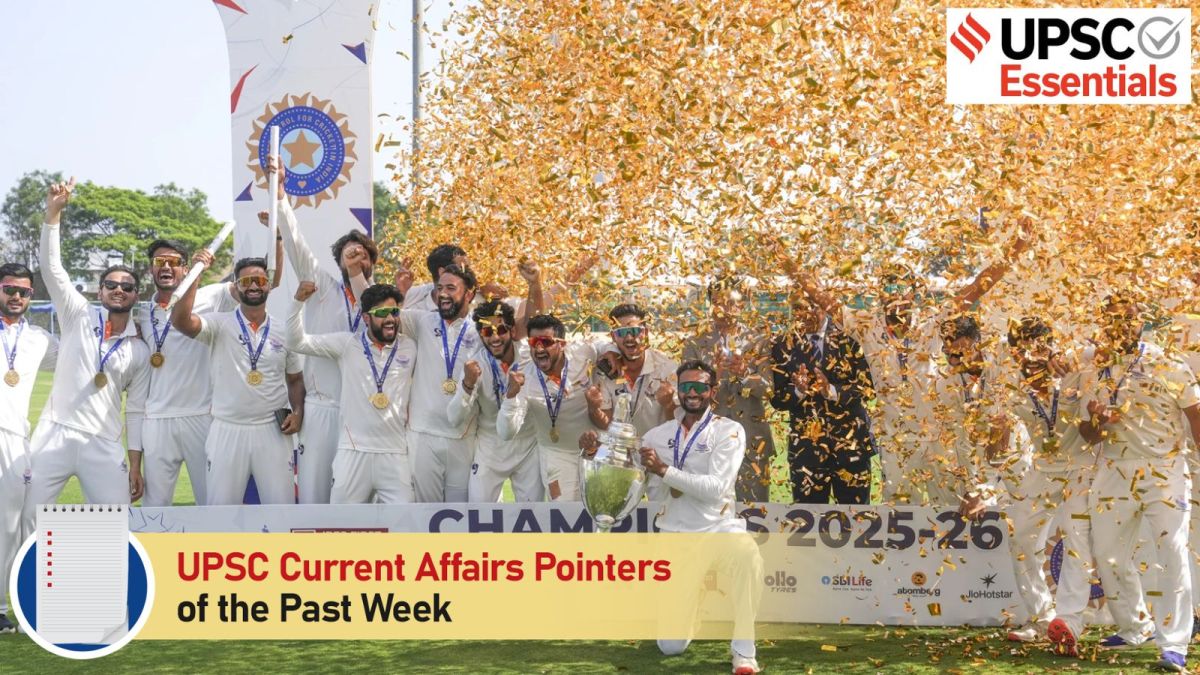
In the realm of sports, Jammu and Kashmir won their maiden Ranji Trophy title in the 2025‑26 season, defeating a strong Karnataka team in the final. This achievement marked a historic moment for the region, reflecting the impact of sustained sports development and talent nurturing in Indian cricket. Key performances by players such as Auqib Nabi, Shubham Pundir, and Qamran Iqbal made this triumph possible.
Relevance for UPSC: While sports achievements may not fall directly under core syllabus areas, they are often referenced in General Knowledge and Current Affairs sections of the Prelims. Recognizing their social and cultural impact — especially in terms of regional representation — can enrich answers and provide holistic insights.
6. Wider International and Economic Developments
Beyond these headline events, the week also featured notable developments in global and bilateral relations:
-
India’s engagement with the International Energy Agency (IEA) continued to strengthen, reflecting energy policy priorities and geopolitics of supply diversification.
-
India hosted the Prime Minister of Canada to deepen economic and talent mobility ties between the two nations, highlighting diaspora and strategic cooperation.
-
Escalating tensions on the Pakistan–Afghanistan border after cross‑border strikes underscored enduring security concerns in South Asia.
-
The United States imposed tariffs on Indian solar products, demonstrating ongoing trade and policy frictions in global commerce.
These developments underline how international relations intersect with economics, security, and strategic policy — key themes for UPSC preparation.
Conclusion: Integrating Key Current Affairs for UPSC Success
The period from February 23 to March 1, 2026 was rich in events that carry relevance for both UPSC Prelims and Mains:
-
Operation Epic Fury highlighted geopolitical volatility and its implications for global security and energy economics.
-
India’s elevation of ties with Israel and the unveiling of PRAHAR reflect strategic positioning and internal security priorities.
-
Public health initiatives like the HPV vaccination campaign point to policy responses to long‑term social health challenges.
-
Sports milestones such as Jammu & Kashmir’s Ranji Trophy victory showcase regional representation and national pride.
UPSC aspirants should internalize both facts and the broader thematic linkages — connecting policy shifts, global dynamics, and domestic developments — to craft balanced answers across GS papers. Keeping abreast of weekly developments through concise pointers and periodic self‑assessment through quizzes can significantly enhance readiness and confidence in tackling current affairs questions in the examination.
